What Women Athletes Want: Tough Love. Straight Talk. Can't Lose.

Brenda Frese, Karl Smesko, Chris DeMarco. Three coaches, three lessons on what it takes to coach ELITE athletes.

Last week, I added Karl Smesko as arguably one of the best active WNBA coaches.
After sweeping the New York Liberty Friday night, 2026 WNBA Defensive Player of the Year Angel Reese, gave us an example of why her WNBA Finals-bound coach is elite.
“I remember a moment in training camp where we were going through drills, and he stopped everybody and told me I had to make two (3s) in a row in front of everybody … we couldn’t resume the drill until I made two in a row,” Reese said.

It's really hard for me to not want to rush success, and Karl told me how patient I had to be with it … You have those tough times, and you have those tough conversations. But it's a coach that really believes in you, and he knows he knows what's best,” Reese said.
Accepting the challenge worked for the better for Reese and the Dream, who shot 32.5% from the perimeter and are 36.4% from deep in the postseason.
“I'm really thankful for him for being able to help me with my career and help me be better for the team because I don't think I would be in this situation and thriving as I am individually without him,” she added.
Yes, Smesko challenged Reese, but he sat in the hard times with her. He knew she needed to overcome her fear and he gave her the opportunities, in a safe environment, to do so.
“That's the reason why I had her do it in front of her teammates … you're going to have to get comfortable shooting this ball in in front of people, and it's brand new to you," Smesko said.
The second year coach wanted his team to improve perimeter shooting, so he had them get used to taking 3-pointers in practice. What started as an uncomfortable situation grew into a competitive edge. Atlanta had a better percentage from the arc than New York in the deciding Game 3.
"I really think once we have one off season to really you know concentrate on it, the sky's the limit,” Smesko said Friday evening at Barclays Center.
In Your Face!

In the Second Round of the 2026 NCAA Women’s Basketball Tournament, we saw 2026 Maryland Athletics Hall of Fame inductee Brenda Frese get in the face of UMD guard Oluchi Okananwa.
Earlier this month at the Big Ten Women’s Basketball Media Day, I spoke to Okananwa and Coach Frese about the viral moment.
“It was an empowering,” Freese told me ahead of her 25th season at Maryland.
“That moment doesn't happen if you don't have the history and the relationship built before it, and I think that's the beauty of what we do from a coaching end," she added.
Frese went on to speak about building the type of culture and trust with her players to know when they need those moments. And that is what Okananwa wants people to remember most.
Despite Maryland losing the game, the world got to see what she already knew about her coach.
“I remember going through my phone and being so shocked of everyone texting me, seeing all the tags, and being like, ‘What is going on? And I remember texting Coach B and telling her, ‘You know, we didn't get the win, not the outcome we wanted, but I am so thankful that we have this silver lining moment of everyone getting to see how an amazing of a coach you are.’”
The senior guard also wants her moment with Coach Frese to be a glowing example of women wanting to be coached fully, no child’s gloves.
“I want to play professionally. That in and of itself, so much work, so much commitment … so having that conversation with her of hey, this is what I want to be. This is where I want to go, and I understand that it's going to take a lot of tough, intense coaching coming from you, and I'm okay with it," Okananwa said.
These examples show the importance of building working relationships with your athletes, and that women can not only take tough criticism, they need it to be successful.
Not All WNBA Coaches Become GOATs
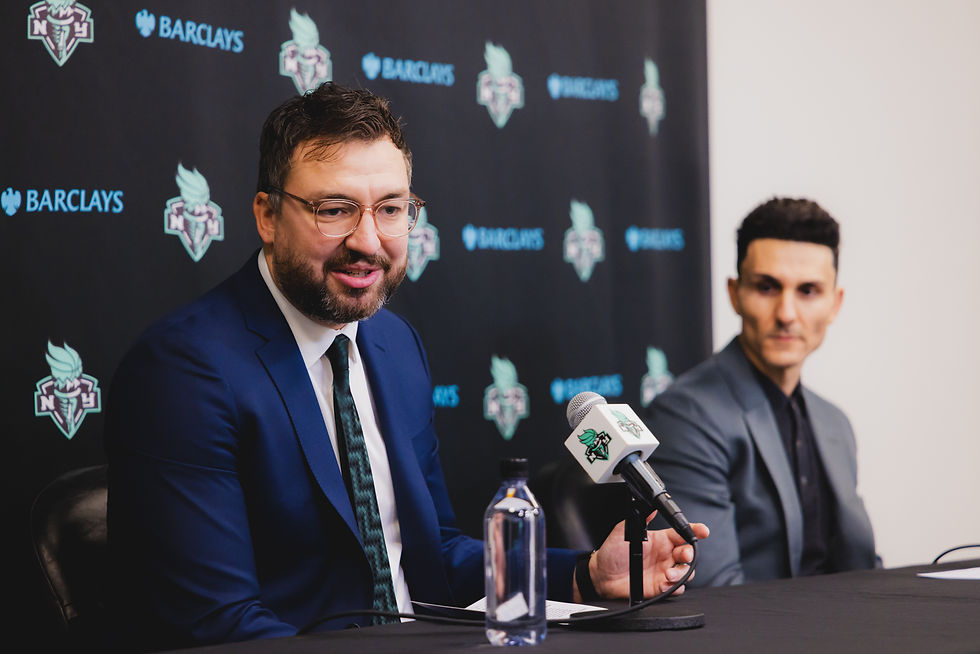
In stark contrast, when Chris DeMarco was asked by his star player Breanna Stewart if he’d take on the timeout fiasco from Game 2, the first-time head coach evaded the topic altogether, leaving Stewart to carry the burden of calling out the miscommunication with the officials.
In that moment, DeMarco seemed unsure, or worse, uninterested in removing the burden from his player. When directly asked, he confirmed he and several others on the coaching staff were told the same thing as Stewart, that the team was out of timeouts.
The New York Liberty have the luxury of a team with Sabrina Ionescu, Jonquel Jones, and a true generational talent in Breanna Stewart.
Unfortunately, this season seemed like a wasted year. The trio all signed through 2028. Can the team course correct and make a stronger push for a title in the next two seasons?
Although DeMarco seemed out of his element, there is risk in moving on from a head coach. Especially when a change at the front office might also be needed.
Chosing not to extend Brondello is what New York Liberty reporter Jackie Powell called a "divorce" between the coaching staff and the front office. Communication seemed to be lacking and it caused challenges in 2025.
After moving on from Brondello, Kolb knew the team needed to make a lasting change.
“We need to nail this ... If we’re going to make a bold decision like this, our players deserve to get the best, and so we’ll take the time necessary.”
Did they nail it?
The fact that we're asking the question is frustrating. Clare Brennan put it well:
"Kolb may feel pressure to own the decision to hire DeMarco, leading him to give the first-year WNBA head coach another season to adapt. But the Liberty GM should be singularly focused on the sand trickling through the hourglass that is Stewart’s prime. The 32-year-old knows how rare a healthy season is and how hard it is to make it to the Finals. With Stewart in the MVP conversation again this year, it’s hard not to ponder the what-ifs."
Whether Kolb and DeMarco were on the same page is up to interpretation, but there were times where the first-year head coach seemed overwhelmed, including in Game 2 of the semifinals where either he and his staff didn't know they had a timeout, or they didn't make enough of a fuss to ensure they had the information correct.
By Chris & Co. not taking that on, it led to a situation where Stewart was pitted in a "he said, she said" with WNBA officials.
This isn't the first time a WNBA star, on the WNBPA executive committee no less, was effectively made out to be a liar.
Lack of Trust is 'Really Disappoining'
When Napheesa Collier used her 2025 exit interview to call attention to the lack of communication with commissioner Cathy Engelbert, the league statement similarly implied Collier was the mistaken party.
Ahead of Game 3, Stewart said she didn't want to rehash the timeout fiasco. She did take the opportunity to express her disappointment in the pool report and league response.
"Putting me in a position to question my integrity is really disappointing. And I know who I am and what I stand for and what I heard and that’s that," the three-time WNBA Champion said.
Players are holding up their end. The question is whether the coaching staffs and officials around them are performing at a WNBA level, and too often this season, they haven’t been.
Women athletes aren’t asking to be coddled. They’re asking for a coach who will get in their face, tell them the truth, and stand beside them when it counts.
Tough love. Straight talk. Can’t lose.


Comments